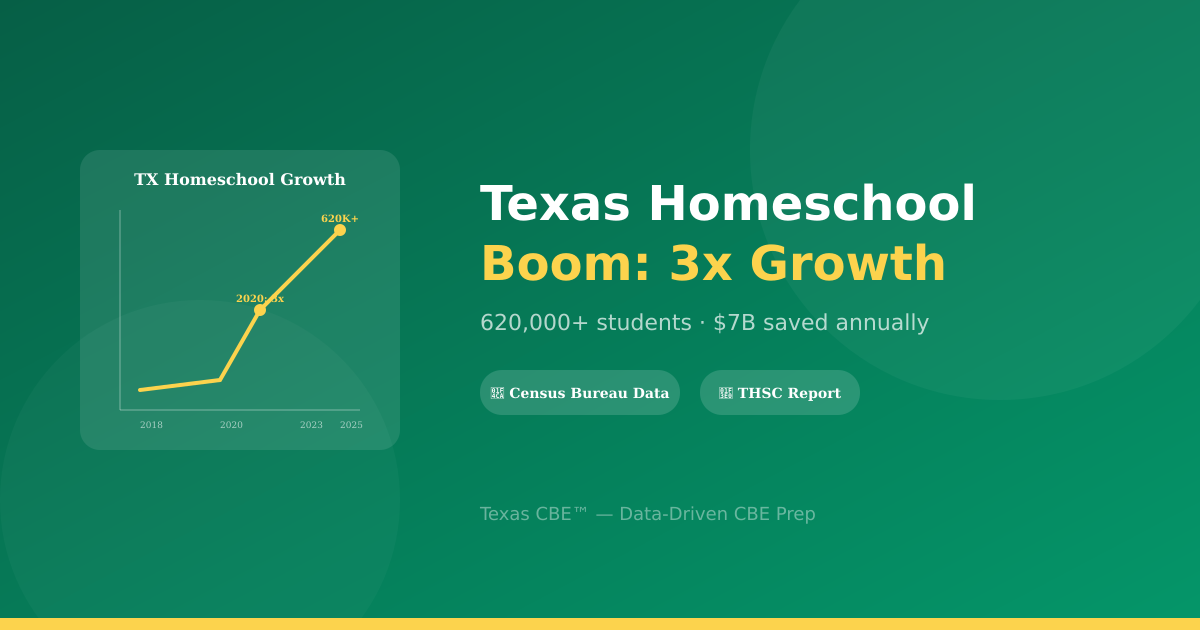
Texas Homeschool Boom: Homeschooling Doubled Since 2020 — and What It Means for CBE


The Numbers: Texas Homeschooling Has Surged
Something dramatic happened to education in Texas starting in 2020. According to the U.S. Census Bureau Household Pulse Survey, the share of U.S. households with school-age children that were homeschooling roughly doubled — rising from 5.4% in spring 2020 to 11.1% in fall 2020 (about a 5.6 percentage-point increase) — and Texas was part of that surge.
The Timeline: How We Got Here
| When | Event | Reported figure |
|---|---|---|
| Spring 2020 | COVID-19 school closures begin | 5.4% of households homeschooling (U.S. Census Bureau) |
| Fall 2020 | Many families choose not to return | 11.1% — roughly doubled (U.S. Census Bureau) |
| Ongoing | Texas public-school students withdraw to homeschool | ~50,000 per year, estimated (THSC) |
| 2024 | Texas's share of the national homeschool rise | ~6% of the national rise, with a reported ~69% increase in the state (Newsweek/THSC) |
| Today | Texas homeschool population (no official count exists) | Estimated 500,000–620,000, roughly 8–10% of students (THSC) |
Important: There is no official count of Texas homeschoolers, because Texas does not require homeschool families to register with the state. Population figures above are estimates from the Texas Home School Coalition (THSC) and reported figures from Newsweek/THSC, not government statistics. The doubling (5.4% to 11.1%) is the U.S. Census Bureau's national Household Pulse Survey measure.
Why Families Are Leaving Traditional Schools
The surge isn't just about COVID anymore. Commonly cited reasons families choose to homeschool include:
- Academic concerns — dissatisfaction with academic quality at the assigned school
- Safety — concerns about school violence and bullying
- Flexibility — a desire for customized schedules and curricula
- Religious or moral values — a desire to integrate faith-based education
- Special needs — individualized attention not always available in large classrooms
The CBE Connection: Why This Matters
Here's the critical link: homeschool families often need a way to earn course credit recorded by a Texas school district. Texas law does not require homeschools to follow a specific state curriculum or to issue transcripts that colleges automatically accept, so families sometimes need an independent way to document mastery on a recognized transcript.
That's where Credit by Exam (CBE) can help. CBE allows homeschool students to:
- Earn course credit recorded by a Texas district for a specific course (for example, Algebra 1)
- Accelerate — skip ahead a grade or course level when a student already knows the material
- Smoothly re-enter public school with credits recognized and recorded by the district
- Build a transcript useful for dual credit, college admissions, and NCAA eligibility considerations
How CBE Actually Works: Two Routes
CBE in Texas is not simply "free" and not simply "paid" — there are two distinct routes, and the cost and passing score depend on which one you use:
| Route | Cost | Passing score |
|---|---|---|
| District-administered CBE (for acceleration) | No charge to the student; districts must offer each board-approved exam at least 4 times per year (TEC §28.023) | 80% to earn credit with no prior instruction (TEC §28.023(c)) |
| University CBE (UT High School / Texas Tech University ISD) | Fee-based, commonly cited around ~$50–$150 per exam (varies); scores transferable to your home district with the district's permission | 70% to earn credit with prior instruction (TAC §74.24) |
Either way, only your school district grants and records the credit. A university such as UTHS or Texas Tech University ISD scores the exam; the district records it on the transcript. This is why understanding both routes — and which one fits your situation — matters before you commit time or money.
What This Means for You
If you're part of the estimated 500,000–620,000 homeschool families in Texas (THSC), or if you're considering homeschooling, CBE is worth understanding as part of your academic plan. It can serve as a bridge between homeschool learning and course credit recorded by a Texas district.
At Texas CBE™, we provide TEKS-mapped practice questions modeled after the official CBE format for popular CBE subjects — so your child can walk into the CBE itself (which they take through their district or a university provider) feeling prepared.
This guide is based on publicly available information about Texas Credit by Exam, the GED/TxCHSE, and Texas homeschool law, and is for general information only — not legal or educational advice. Policies, fees, score requirements, and accepted providers vary by district and change over time. Always verify current requirements directly with your school counselor, your district's CBE coordinator, UT High School (UTHS), the Texas Education Agency (TEA), and GED Testing Service before making decisions. Texas CBE™ is an independent practice platform; it is not affiliated with, endorsed by, or operated by TEA, UTHS, Texas Tech University ISD, GED Testing Service, the College Board, or any school district, and it does not administer the CBE or GED or grant academic credit.
Sources: U.S. Census Bureau Household Pulse Survey (2020), Texas Home School Coalition (THSC), Newsweek, National Center for Education Statistics (NCES).