Question 1 of 10
Which molecule carries energy from glucose breakdown to the electron transport chain?
A ATP
B CO2
C H2O
D NADH
Explanation
📌 NADH and FADH2 are electron carriers. They transport high-energy electrons from glycolysis and Krebs cycle to the ETC.
Question 2 of 10
Which organelle is labeled X in the cell diagram below? 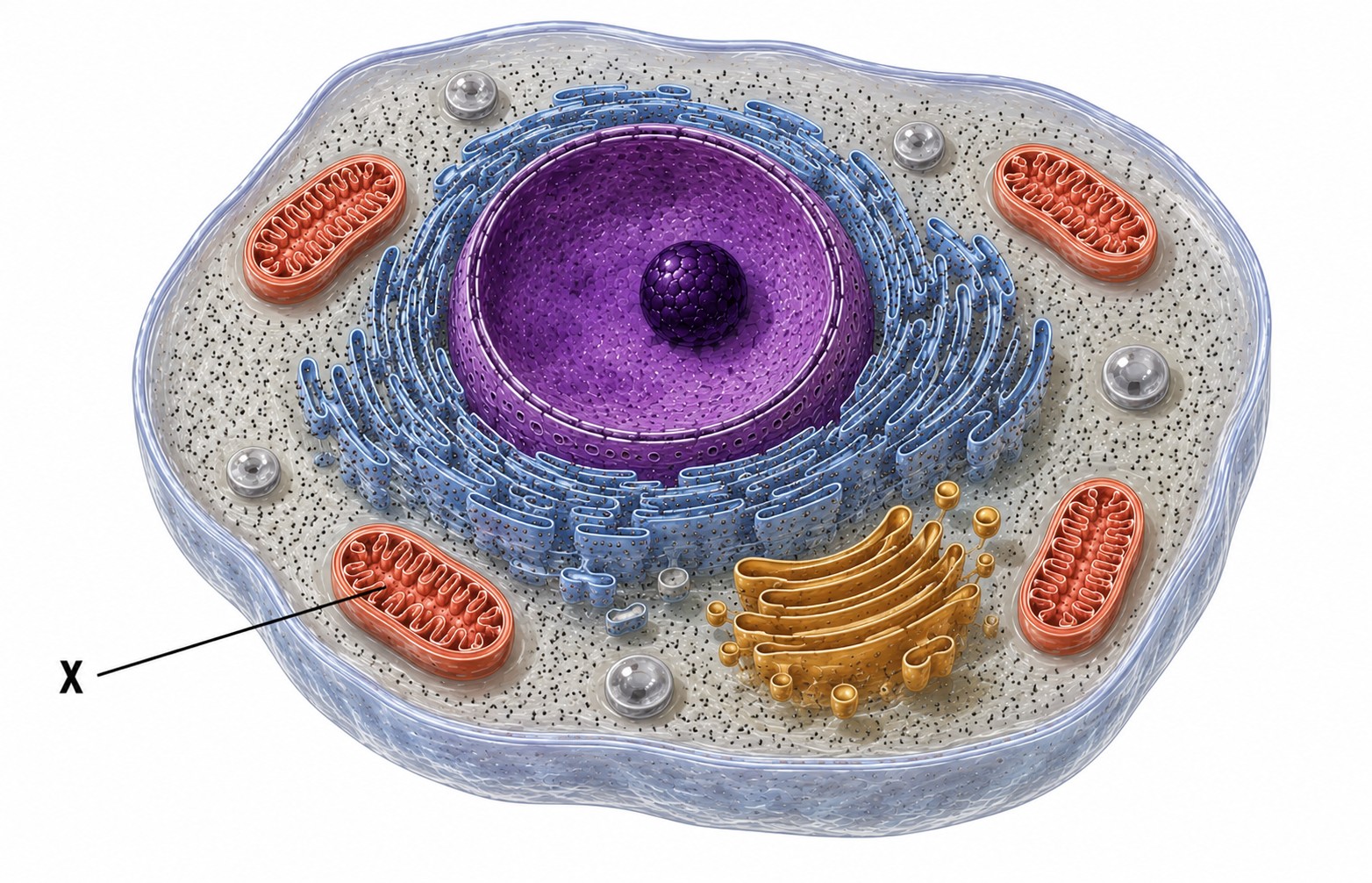
A Mitochondria
B Nucleus
C Golgi apparatus
D Endoplasmic reticulum
Explanation
📌 Organelle X has the bean-shaped structure with inner folds (cristae) → Mitochondria
Mitochondria = powerhouse of the cell = produces ATP through cellular respiration
C₆H₁₂O₆ + 6O₂ → 6CO₂ + 6H₂O + ATP
Mitochondria = powerhouse of the cell = produces ATP through cellular respiration
C₆H₁₂O₆ + 6O₂ → 6CO₂ + 6H₂O + ATP
Question 3 of 10
Which graph correctly shows exponential growth?
A Both
B B
C A
D Neither
Explanation
📌 Exponential growth = J-shaped curve (slow start, rapid increase)
Linear growth = straight line (constant rate)
Graph A shows exponential growth.
Linear growth = straight line (constant rate)
Graph A shows exponential growth.
Question 4 of 10
All three domains of life (Bacteria, Archaea, and Eukarya) share which structural feature?
A Ribosomes for protein synthesis
B A membrane-bound nucleus
C Multicellular organization
D Chloroplasts for photosynthesis
Explanation
All cellular life — Bacteria, Archaea, and Eukarya — uses ribosomes to build proteins. Distractors: a membrane-bound nucleus is found only in Eukarya (Bacteria and Archaea are prokaryotic). Multicellularity appears only in some Eukarya — most life is unicellular. Chloroplasts are organelles found only in plants and algae (a subset of Eukarya).
Question 5 of 10
In a DNA nucleotide, which component carries the genetic code through its specific sequence?
A Phosphate group
B Hydrogen bond
C Nitrogenous base
D Deoxyribose sugar
Explanation
The nitrogenous base (adenine, thymine, guanine, or cytosine) is the part of a DNA nucleotide that varies — its sequence along the strand IS the genetic code. The phosphate and deoxyribose sugar are identical in every nucleotide and form the structural 'backbone' of the DNA strand; they don't store information. Hydrogen bonds hold the two strands together at the bases but are not part of a single nucleotide.
Question 6 of 10
A theory in science is:
A the same as a hypothesis
B a proven fact that can never change
C a well-supported explanation based on extensive evidence
D an untested guess
Explanation
📌 A scientific theory is well-tested, widely accepted, and explains a broad range of observations.
It is NOT just a guess — that's a hypothesis.
It is NOT just a guess — that's a hypothesis.
Question 7 of 10
The graph shows the change in a moth population over time. Dark moths increased after industrial pollution darkened tree bark. This is an example of:
A Genetic engineering
B Spontaneous generation
C Artificial selection
D Natural selection
Explanation
📌 This is the classic peppered moth example of natural selection.
Before pollution: light bark → light moths camouflaged → survived
After pollution: dark bark → dark moths camouflaged → survived
The environment selected for the trait that provided camouflage.
Before pollution: light bark → light moths camouflaged → survived
After pollution: dark bark → dark moths camouflaged → survived
The environment selected for the trait that provided camouflage.
Question 8 of 10
The Hardy-Weinberg principle states that allele frequencies remain constant when:
A natural selection is strong
B there is no evolution occurring
C mutations are common
D the population is very small
Explanation
📌 Conditions: no mutation, no migration, random mating, large population, no natural selection.
Any violation → evolution occurs.
Any violation → evolution occurs.
Question 9 of 10
A student designed an experiment to test how light affects plant growth. Identify the components of this experiment. 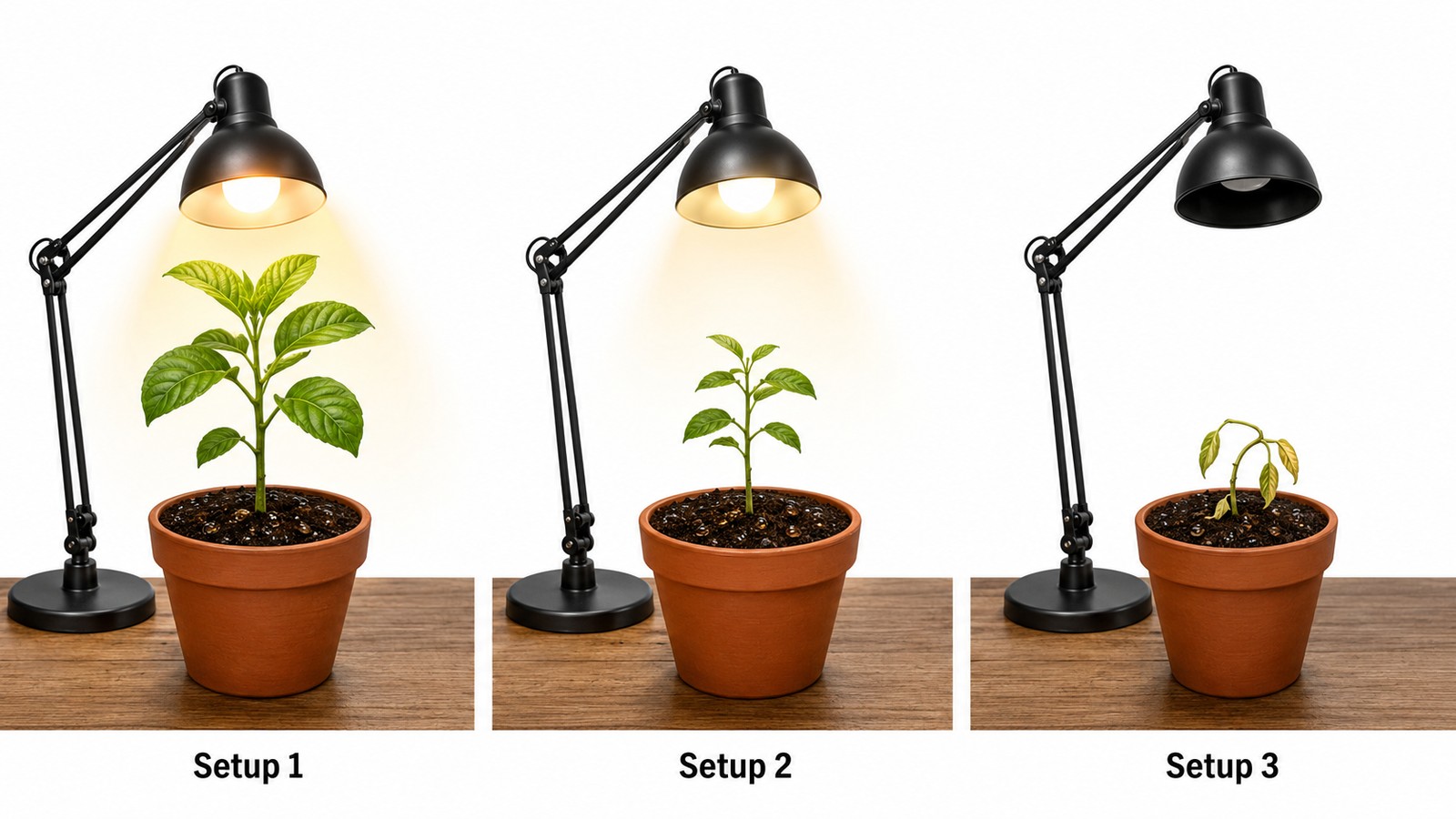
A Independent: light; Dependent: plant height
B Independent: water; Dependent: soil
C Independent: plant height; Dependent: light
D Independent: temperature; Dependent: light
Explanation
📌 Independent variable = what you change (light)
Dependent variable = what you measure (plant height)
Control group = no light (to compare against)
Constants = same soil, water, temperature, pot size
Dependent variable = what you measure (plant height)
Control group = no light (to compare against)
Constants = same soil, water, temperature, pot size
Question 10 of 10
During which phase of the cell cycle does DNA replication occur? 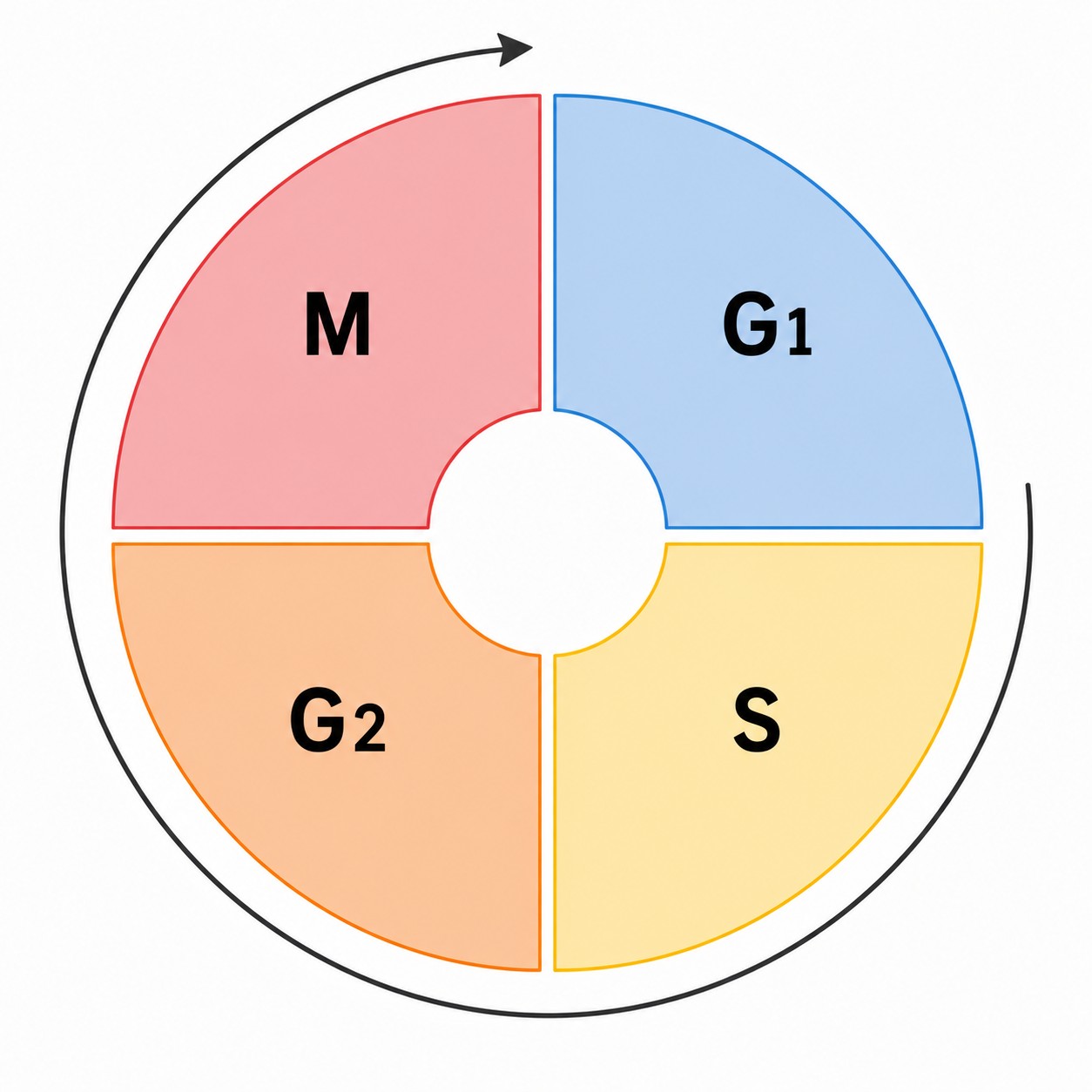
A S phase
B G1 phase
C G2 phase
D M phase
Explanation
📌 DNA replication occurs during S phase (Synthesis) of interphase.
Interphase: G1 → S → G2, then Mitosis.
Interphase: G1 → S → G2, then Mitosis.